Roughly 20 years into the reign of mobile computing devices, those of us who keep apace of such things are probably used to the pageantry of product announcements. The grandiloquence of the painstaking choreography makes an incredulous observer roll their eyes.
But Flipper is one of those rare tech companies that can make announcements that instantly generate unalloyed excitement. The kind that blew right past "oh, huh, that could be useful on my work phone" and into "I can't wait to block out an entire weekend with this thing" territory.
Granted, last month's post on Flipper's official blog wasn't quite that, but it was far from a disappointment. It just wasn't what you might expect. Instead of dangling scant, tantalizing details over fans, Flipper opened its doors to let the community dive right in. Flipper CEO Pavel Zhovner declared as much in no uncertain terms.
"The main reason we opened up all parts of Flipper One before release is that we want to invite the community into the development process, so everyone can contribute and get involved without waiting for the final product," Zhovner said.
Count to Zero, Then One
Flipper's first foray into hardware, the Flipper Zero, is beloved in the hacker/pentester community (choose your preferred nomenclature). Its cheeky, cyberpunk-inflected pwnagotchi interface endeared itself to users, who found excuses to whip it out. But its arsenal of radio-protocol tools, packed into a palm-sized gadget, can do serious work, as evidenced by its presence in the toolbelt of information-security heavy-hitters.
"The Flipper Zero is one of my favorite devices of all time," said Josh Bressers, VP of security at Anchore and host of "Open Source Security" podcast.
While the community is still fond of the Flipper Zero, they're also ready for Flipper's next chapter and its attendant new capabilities. "I think it's a continuation of what Flipper Zero started," Bressers said. "The features of the Flipper Zero are certainly a bit stale these days."
If anything is true about technology, it's that more of the same just doesn't cut it. Flipper wants to swim at the front of the school, and the forward-thinking woven into the Flipper One planning is proof. Truly, the product was dreamt up before the hardware to support it existed.
"Since 2020, I've been talking about the separation of Flipper Zero and Flipper One," Zhovner said. "One of the reasons we didn't do this sooner was the lack of a suitable SoC [system on a chip] that was simultaneously fast, energy-efficient, and sufficiently open. In 2024, the RK3576 came out, and once we realized it was open enough, we decided the time was right."
In refusing to settle, Flipper ended up preparing for tomorrow — in their assessment, tomorrow has arrived.
The blueprints are ambitious. Flipper One takes the radio-Swiss-Army-knife concept that made Flipper a hackerspace name and sticks a fully customizable Linux OS at its heart.
Serving up the redoubtable Linux userland is FlipCTL, which wraps CLI tools for easy manipulation in the cyberdeck form factor (you have no idea how long I've wanted to write "cyberdeck" in a serious article). Not to be outdone by the likes of the Steam Deck, Flipper One will be just a keyboard and monitor away from acting as a desktop, a capability mainstream consumer tech passed up, but the Linux hardware community keeps alive.
The networking hardware is where hacker types will really get amped up, though. For starters, it boasts a full software-defined radio (SDR), a capability likely to appeal to amateur radio enthusiasts and the growing ecosystem around projects like Meshtastic. On top of that, it adds a satellite modem just in time for satellite communication security to ramp up and companies to explore orbital data centers.
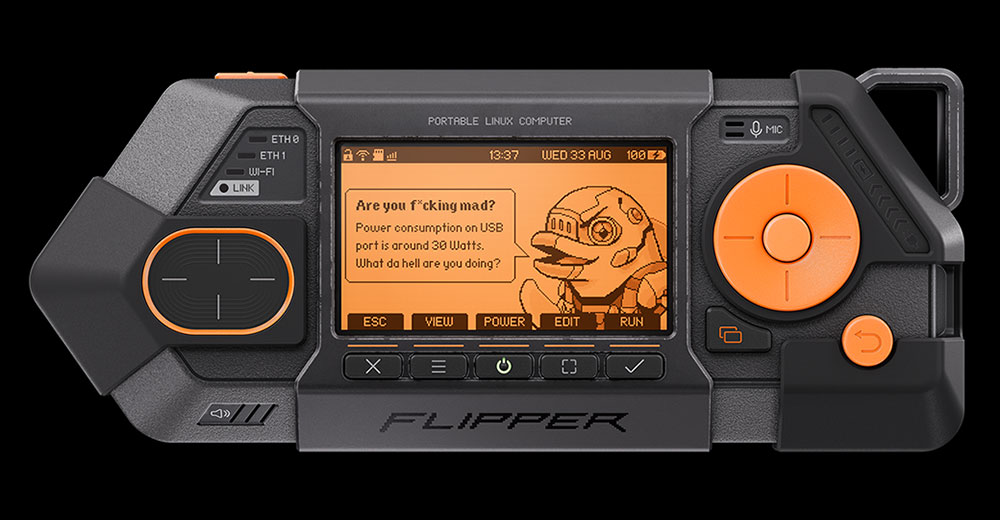
Flipper One is designed to combine Linux, software-defined radio, and networking tools in a portable handheld platform for hardware hackers.
It's also notable that, building around a single-board computer (SBC) with a neural processing unit (NPU), Flipper One could very well be the first end-user Linux device to ship with an LLM preinstalled. Microsoft has the distinction of bringing the first LLM-equipped PCs to market, but let's just say not everyone interested in that likes Microsoft's particular spin.
Chip Off the Old Rock
There are technical hurdles to clear, but they are surmountable. In committing to true "open hardware" (the hardware analog to open-source), Flipper aims for a device that doesn't need to resort to tricks to run stock Linux kernels. Achieving this involves adding the modules that drive Flipper One's hardware to the Linux kernel source code.
"Almost everything Flipper One needs is already in the mainline kernel ... So we're not worried about this at all," Zhovner said. "And fortunately, we're not the only ones interested in mainlining RK3576 — other companies are working on it too."
Bressers also did not view the prospect of mainlining the required kernel modules as especially difficult. "I have no doubt the Linux kernel will take any contributions that follow their rules," he said.
The RK3576 system-on-chip from Rockchip has been out since late 2023. Since then, multiple projects have driven additions to the Linux kernel to support the board. It was designed to suit the burgeoning AIoT class of devices, blending artificial intelligence (AI) with internet of things (IoT) to facilitate applications that perform sophisticated edge compute data processing. Using it to power an SBC for end-users is yet another way Flipper is reimagining the future from bits of the present.
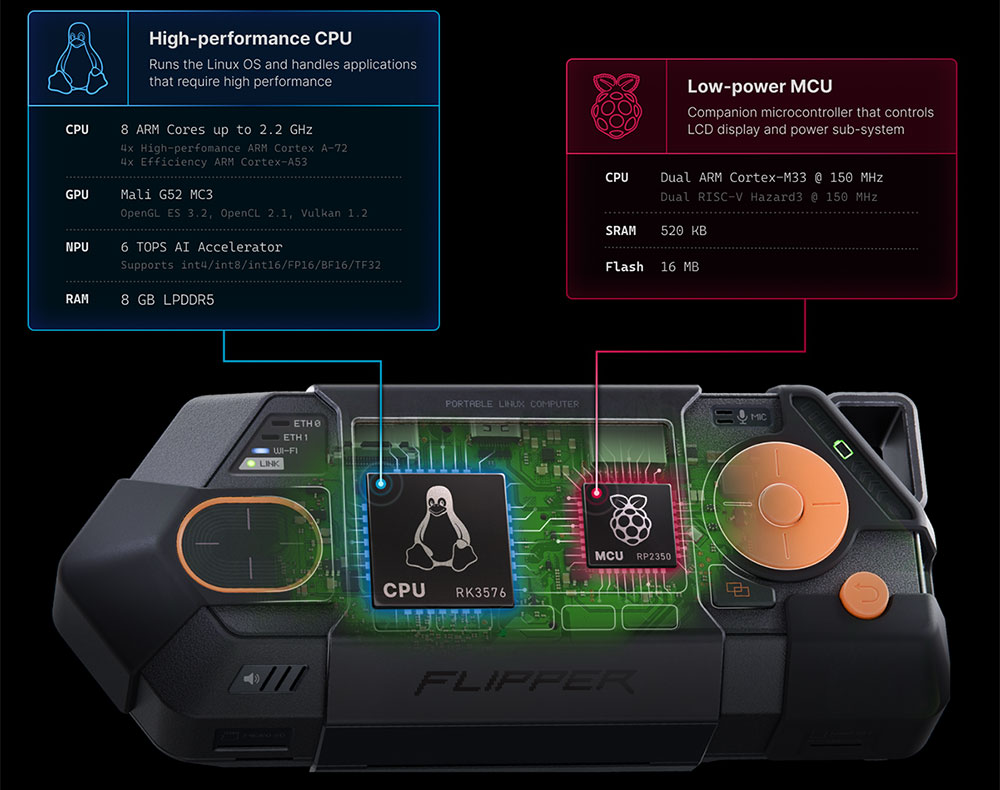
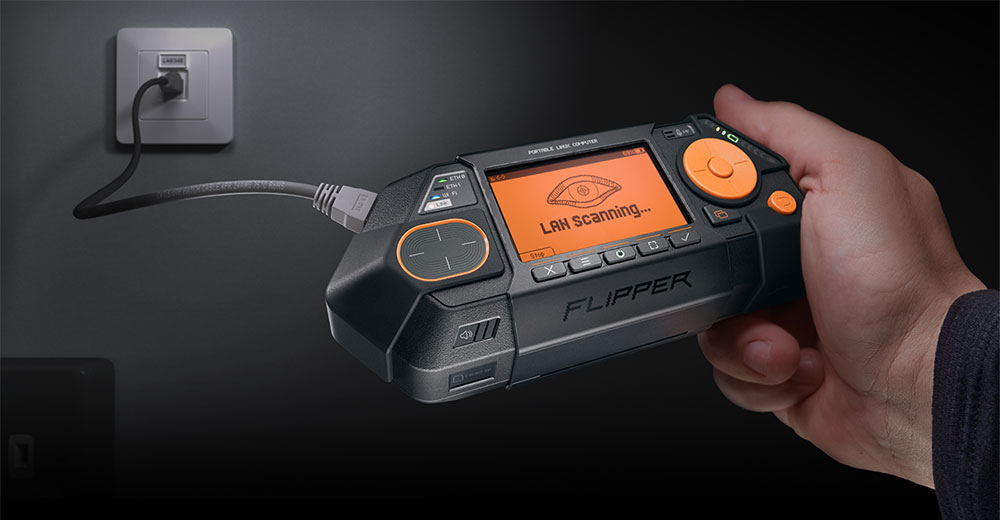
Flipper One pairs a high-performance RK3576 processor that runs Linux with a companion microcontroller that manages the display and power subsystem.
As many components as are packed into the handheld, Flipper maintains that all of them pass their unit tests. The trick is getting them all to play nice. Every additional component exponentially increases the testing workload to ensure everything interoperates harmoniously.
"The current work is systematically identifying all potential side effects across hardware combinations, which requires the firmware to be mature enough to run multiple features concurrently," Zhovner said. "So in a sense, the testing and the development have to advance together."
All Hands on Deck
This is where Flipper is plunging the deepest into uncharted territory: leaning on community contributions before launch. Good open-source citizens that they are, Flipper posted the Flipper Zero's firmware after it shipped. But the point of the May announcement was less to show off previous work, and more to get help on the work that remains. To that end, the company is not shrinking from opening itself up to the level of coordination necessary to pull this off.
"With Flipper One, we decided to go even further and open up the task tracker as well, so anyone can see how the team communicates internally and how we make decisions," Zhovner said.
More than merely extending an invitation, Flipper put out a welcome mat. For prospective contributors wondering how they develop for hardware they don't have, the team published documentation on compatible boards that are already available.
Summer Soldier and Wintermute
The very innovation that helped make the RK3576 appealing as the basis of the Flipper One — AI — poses the most serious challenge to the quest for the ultimate open project. AI coding assistants have been in the hands of plebeian developers for only a few years, but open-source veterans already consider AI policies indispensable to ensure high-quality contributions.
"For the community contributions that [Flipper is] looking for, which will affect the base operating system, those will probably need a policy that evolves with the contributions proposed," Bressers said.
Flipper is well aware of this. In fact, they know firsthand what the absence of an AI policy invites. Although the exact stipulations are still in flux, an AI policy is taking shape.
"Yes, the AI slop problem has hit us, too," Zhovner said. "So yeah, it's a challenge, we're figuring out how to guard against it and working on establishing some ground rules."
Making Waves or Ripples
One question sure to be on any backer's mind is, will the device clock in at its price target? Given the component market crunch precipitated by AI hyperscaler buying sprees, this is a trickier needle to thread than the last time around. The $350 figure is where the team is hoping to land the Flipper One base configuration, which won't include the cellular modem.
That's where faith from fans makes or breaks the endeavor. In view of market conditions beyond a manufacturer's control, the way to secure the best offers is to front-load customer commitment.
"That's why hitting a significant Kickstarter funding goal is critical — it directly affects the terms our suppliers offer us," Zhovner said. "Given the ongoing component and RAM shortage, this is no easy feat right now."
Bressers, for one, estimates that a price point in this ballpark is realistic.
"I think it's plausible. A Raspberry Pi 5 with 16GB of RAM is about $300," Bressers noted. "The Flipper One is supposed to have 8GB, so less RAM, but there are other added costs like the screen and radios."
With a Discord of over 116,000 members, there are likely enough die-hard fans to fund the device's first production run far enough out to give the company purchasing leverage with suppliers.
So, what kind of consumer tech landscape will receive the Flipper One when it lands? As a self-proclaimed Flipper Zero fan and someone squarely in Flipper's target audience, Bressers regards the effort as perhaps not groundbreaking but as continuing to serve the niche of aspiring hackers in need of an eminently capable starter pack.
"It won't change the industry, but it sounds like it will continue to be an easy way to start a hardware hacking journey," Bressers said.
Images courtesy of Flipper Devices




















 Loading ...